
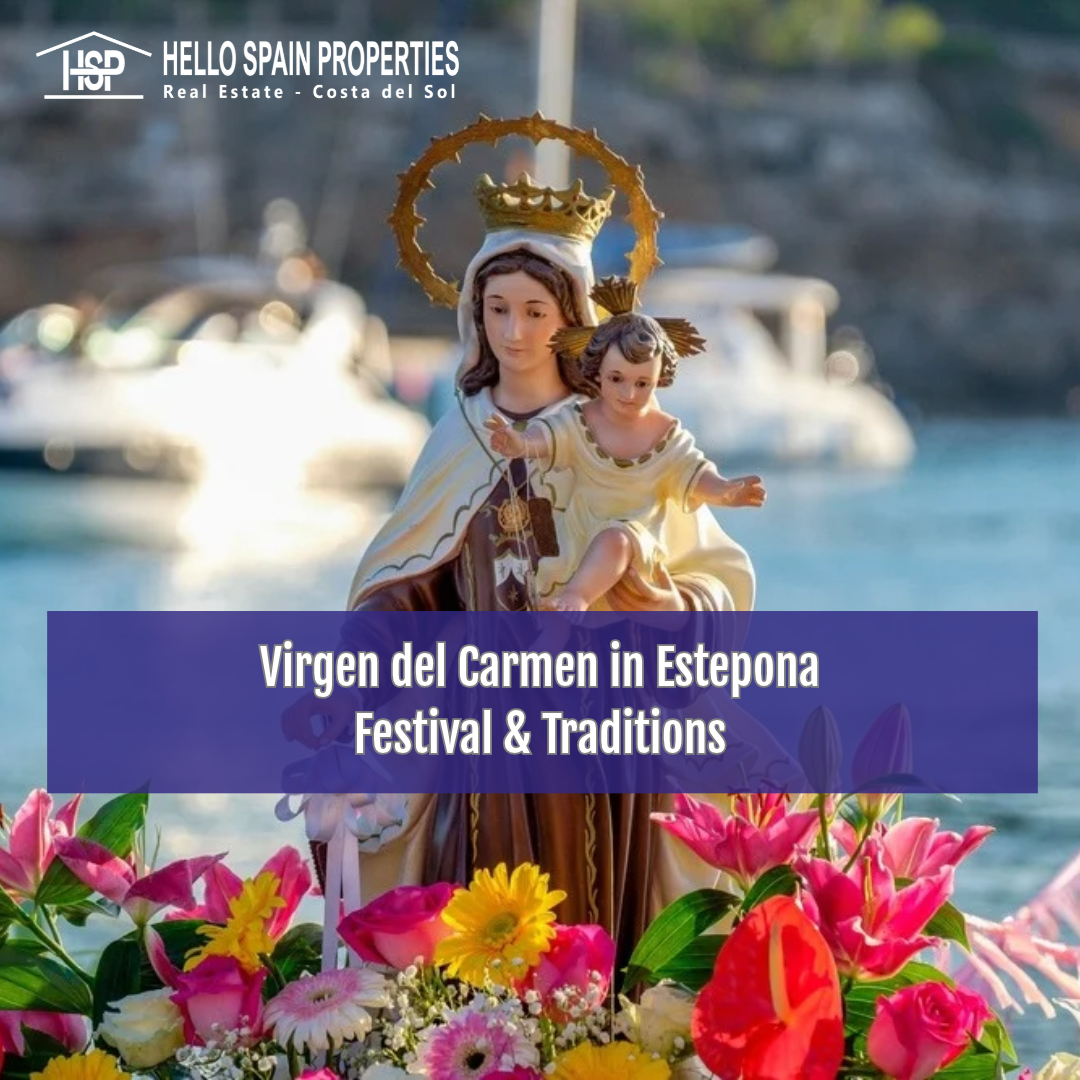
Virgen del Carmen in Estepona is one of the town’s most cherished annual celebrations, held every 16 July in honour of Our Lady of Mount Carmel, the patron saint of Estepona and protector of sailors and fishermen. The festivities bring together local families, fishing communities and visitors for religious services, traditional activities and a spectacular procession through the streets and out onto the Mediterranean Sea. The sight of the Virgin being carried into the water, accompanied by decorated fishing boats, is an unforgettable expression of Estepona’s maritime heritage and strong community spirit.
A Celebration at the Heart of Estepona’s Traditions
Every summer, something rather special happens in Estepona.
The town’s streets fill with people, the fishing boats are decorated, and families gather along the seafront to celebrate a tradition that has been passed down through generations.
The occasion is the feast of the Virgen del Carmen, one of the most important dates in Estepona’s local calendar.
For visitors, it is a wonderful opportunity to experience authentic Andalusian culture. For local residents, it represents something much deeper: a connection to the sea, to their families and to the history of the town they call home.
And for anyone considering making Estepona their home, celebrations like this offer a lovely glimpse into the community spirit that makes this part of the Costa del Sol so appealing.
What Is Virgen del Carmen and Why Is It Celebrated?
Virgen del Carmen, known in English as Our Lady of Mount Carmel, is a revered figure in the Catholic tradition and is particularly important in Spain’s coastal communities.
She is widely recognised as the patron saint and protector of sailors, fishermen and those whose livelihoods depend on the sea.
For generations, fishing families have turned to the Virgen del Carmen for protection, especially when loved ones were working aboard fishing boats.
Her feast day is celebrated on 16 July each year, with religious services and maritime processions taking place in coastal towns throughout Spain.
In Estepona, the celebration has particular significance because of the town’s long relationship with fishing and the Mediterranean.
The Virgen del Carmen is also the patron saint of Estepona itself, making the annual festivities an important occasion for the whole community.
When Is Virgen del Carmen Celebrated in Estepona?
The main celebration takes place on 16 July every year.
Although the date remains the same, the programme of religious services, processions and accompanying activities may change slightly from year to year.
| Event | What to expect |
|---|---|
| Feast day | 16 July |
| Religious celebrations | Masses, prayers and traditional devotions |
| Local festivities | Activities associated with Estepona’s fishing community |
| Land procession | The Virgin is carried through the streets towards the seafront |
| Maritime procession | The Virgin travels out to sea accompanied by decorated boats |
| Evening atmosphere | Residents and visitors gather along the waterfront to celebrate |
Some years also feature additional music, activities and fireworks.
If you’re planning a visit specifically for the celebration, it’s worth checking the official programme closer to the date.
The History of Virgen del Carmen in Estepona
Long before Estepona became a popular destination for international property buyers, fishing was central to everyday life in the town.
Generations of local families depended on the Mediterranean for their livelihoods.
Fishing boats would leave the harbour early in the morning, returning with their catch to supply local markets, restaurants and households.
The sea provided employment and sustenance, but it also brought uncertainty.
For fishing families, devotion to the Virgen del Carmen became an important expression of faith, hope and protection.
The modern maritime procession developed during the twentieth century, building upon the town’s religious and seafaring traditions.
Today, although Estepona has grown into a thriving coastal destination, its fishing heritage remains an important part of its identity.
The annual celebration helps preserve that connection between past and present.
The Traditional Land Procession Through Estepona
One of the highlights of Virgen del Carmen in Estepona is the procession through the town.
The beautifully decorated image of the Virgin is carried through the streets by devoted participants, often accompanied by music, prayers and large crowds.
Flowers adorn the procession, and residents gather along the route to pay their respects.
The atmosphere is both solemn and joyful.
For many local families, attending the procession is an annual tradition, with several generations coming together to take part.
The procession is closely associated with the Church of Nuestra Señora del Carmen and Estepona’s seafront, although the precise route and timings should always be confirmed for each year’s celebration.
Even if you’re not religious, witnessing the procession offers a fascinating insight into the traditions that continue to shape Andalusian life.
The Maritime Procession: When the Virgin Meets the Sea
Perhaps the most memorable part of the celebration comes when the procession reaches the Mediterranean.
The image of the Virgen del Carmen is carried towards the water, where fishermen and other participants carefully bring her into the sea.
It is an emotional moment, often accompanied by the traditional Salve Marinera, a hymn closely associated with sailors and maritime devotion.
The Virgin is then placed aboard a decorated vessel for the maritime procession.
Fishing boats and other participating vessels gather around her, their flags and decorations creating a colourful spectacle against the Mediterranean backdrop.
As the boats make their way along the coastline, horns sound and people watching from the shore applaud.
For many residents, this is the most meaningful moment of the entire celebration.
It represents the town’s gratitude for the sea and its continuing respect for the generations who have worked upon it.
Where to Watch Virgen del Carmen in Estepona
If you’re visiting Estepona for the first time, there are several places worth considering when planning to watch the festivities.
<text weight=”medium”>Popular viewing areas</text>
| Location | Why visit |
|---|---|
| Paseo Marítimo | A popular place to experience the procession and waterfront atmosphere |
| Playa de La Rada | Offers views towards the sea and the maritime procession |
| Estepona fishing port area | Closely connected with the town’s fishing heritage |
| Streets along the announced route | Ideal for experiencing the land procession at close range |
The seafront can become busy during the celebration, particularly when the Virgin approaches the water.
Arriving early will give you more time to find a suitable place and enjoy the atmosphere.
If you’re visiting with children, choose a comfortable viewing location with easy access to refreshments and facilities.
Local tip: July evenings in Estepona can remain warm, so comfortable footwear, drinking water and a little patience are worthwhile. Remember that this is an important religious occasion for local families, and allow space for those participating in the procession.
Traditional Music, Flowers and Festive Atmosphere
The Virgen del Carmen celebration is a feast for the senses.
The sound of traditional music fills the streets, flowers decorate the Virgin’s image, and the seafront becomes a gathering place for residents of all ages.
The maritime procession is particularly striking as decorated boats travel across the water, often accompanied by applause and the sound of their horns.
In some years, fireworks have formed part of the celebrations, adding a spectacular finale to the evening.
However, fireworks and other entertainment should not be assumed to take place every year without checking the official programme.
What remains constant is the sense of occasion.
It is a day when Estepona celebrates its faith, its maritime traditions and the community that has grown around them.
Why Virgen del Carmen Is So Special to Local Residents
What makes Virgen del Carmen in Estepona particularly memorable is that it is not simply an event organised for visitors.
It is a deeply rooted local tradition.
Fishing families, religious associations, musicians and residents all play an important role in keeping the celebration alive.
For some, the day is an expression of religious devotion.
For others, it is an opportunity to honour their family’s history or celebrate the town’s maritime identity.
And for newer residents, it provides a welcoming introduction to the customs and traditions of their adopted home.
This is one of the things that makes living in Spain so rewarding.
Beyond the sunshine and beaches, there are communities with their own histories, celebrations and ways of life.
Taking part in these occasions helps newcomers feel connected to the place they have chosen to call home.
Discovering Estepona Beyond the Celebrations
Although Virgen del Carmen is one of Estepona’s most important traditions, there is plenty more to discover throughout the year.
Estepona has developed an excellent reputation for its attractive Old Town, beautiful beaches, modern amenities and relaxed Mediterranean atmosphere.
Its historic centre is particularly charming, with whitewashed streets, colourful flowerpots, independent shops and welcoming cafés.
The town also offers a long beachfront promenade, a marina, restaurants and a variety of established residential neighbourhoods.
Unlike destinations that become quiet outside the summer season, Estepona has an active year-round community.
For international residents, this provides a wonderful balance between traditional Spanish living and the conveniences of a modern coastal town.
Whether you enjoy walking along the seafront, visiting local markets or exploring the surrounding countryside, Estepona offers plenty of opportunities to enjoy everyday life.
Local Insight from Hello Spain Properties: The Appeal of Estepona’s Community
At Hello Spain Properties, our more than 30 years of Costa del Sol real estate experience have given us a strong appreciation for the character of the region’s different towns and neighbourhoods.
When international buyers first explore Estepona, they are often attracted by its beaches, attractive properties and Mediterranean climate.
But choosing somewhere to live involves much more than finding a beautiful home.
The atmosphere of the neighbourhood, access to local amenities and opportunities to become part of the community are equally important.
Traditional celebrations such as Virgen del Carmen offer a glimpse of the authentic Spanish lifestyle that exists alongside Estepona’s modern developments.
For buyers considering a permanent move, spending time in the town throughout different seasons can help them understand whether it suits their lifestyle.
Our advice: Explore Estepona beyond the main tourist areas. Visit the Old Town, spend time around the fishing port and discover the residential neighbourhoods. You’ll gain a much better understanding of what makes the town special.
Living in Estepona: Where Tradition Meets Modern Coastal Living
Estepona has become increasingly attractive to international buyers seeking a home on the western Costa del Sol.
One of its greatest strengths is the variety of lifestyles available within a relatively compact coastal area.
Some buyers prefer the convenience of living close to the Old Town, where shops, restaurants and traditional Spanish life are within walking distance.
Others are attracted to the marina and nearby beachfront neighbourhoods.
Families and buyers looking for more space may prefer residential communities on the outskirts of town or along the New Golden Mile.
| Area | Lifestyle appeal |
|---|---|
| Estepona Old Town | Traditional Andalusian atmosphere, cafés and walkable streets |
| Estepona Marina | Waterfront restaurants, boating and coastal living |
| La Rada beachfront | Easy access to the promenade, beach and town amenities |
| New Golden Mile | Contemporary developments, beaches and established residential communities |
| Residential areas around Estepona | A range of apartments, townhouses and villas for different lifestyles |
Each area has its own advantages, and the best choice will depend on your priorities, budget and how you intend to use your property.
Read our Reasons to Buy Property in Marbella guide which is a useful comparison for buyers exploring different Costa del Sol destinations.
Making Estepona Your Home on the Costa del Sol
For many international buyers, discovering local traditions is part of the pleasure of moving to Spain. Celebrations such as Virgen del Carmen demonstrate that Estepona is much more than a beautiful coastal destination.
It is a town with history, strong community connections and a distinctive Andalusian identity.
If you’re considering purchasing a property here, understanding the practical side of buying in Spain is also important.
Read our Property Purchase Process on the Costa Del Sol for a step-by-step guide to reserving a property, legal checks, contracts and completion.
Understand the purchase taxes and additional costs associated with buying property in Andalucía by reading our guide to Property Taxes on the Costa del Sol.
Lastly our Visa Options on the Costa del Sol guide gives you helpful information for international buyers considering a permanent move to Spain.
At Hello Spain Properties, we help buyers explore the different areas of the Costa del Sol and find properties that suit their lifestyle.
Contact Hello Spain Properties to discover more about living and buying property in Estepona.
Frequently Asked Questions About Virgen del Carmen in Estepona
1. When is Virgen del Carmen celebrated in Estepona?
Virgen del Carmen is celebrated in Estepona on 16 July every year. The day honours Our Lady of Mount Carmel, the town’s patron saint and protector of sailors and fishermen. Religious services, traditional activities and the famous land and maritime processions are central parts of the annual celebration.
2. What is the Virgen del Carmen procession in Estepona?
The Virgen del Carmen procession is a religious and maritime tradition in which the image of the Virgin is carried through Estepona’s streets and taken out onto the Mediterranean Sea aboard a decorated vessel. Fishing boats and other participating vessels accompany her, while residents and visitors gather along the seafront.
3. Where does the Virgen del Carmen procession take place?
The procession traditionally involves the Church of Nuestra Señora del Carmen, streets leading towards the seafront, Paseo Marítimo and the waters off Estepona. Playa de La Rada is closely associated with the maritime celebrations. Exact routes and viewing arrangements may change, so check the annual programme before attending.
4. Why is Virgen del Carmen important to Estepona?
Virgen del Carmen is Estepona’s patron saint and has a particularly strong connection with the town’s fishing heritage. For generations, local families have honoured her as the protector of sailors. The annual celebration brings together religious devotion, maritime traditions and community pride, making it one of Estepona’s most meaningful cultural occasions.
5. Can tourists attend the Virgen del Carmen celebrations?
Yes. Visitors are welcome to experience the public celebrations and watch the processions. The event provides an excellent opportunity to discover authentic local traditions. As it is also an important religious occasion, visitors should be respectful of participants and follow any guidance provided by organisers or local authorities.
6. What is the best place to watch Virgen del Carmen in Estepona?
Estepona’s Paseo Marítimo and Playa de La Rada are popular places to watch the maritime procession. Streets along the official route offer opportunities to experience the land procession. Arriving early is advisable because large crowds can gather near the seafront when the Virgin is carried towards the water.
7. Are there fireworks during Virgen del Carmen in Estepona?
Fireworks have featured in some Virgen del Carmen celebrations in Estepona, but they should not be assumed to take place every year. The programme can change depending on local arrangements. Visitors hoping to see fireworks should check the official event schedule before making plans.
8. Is Virgen del Carmen celebrated elsewhere on the Costa del Sol?
Yes. Virgen del Carmen is celebrated in several coastal communities across the Costa del Sol, including Marbella, Fuengirola and other towns with maritime traditions. Celebrations often include religious services and processions, although the programme and local customs vary from place to place.
9. Is Estepona a good place to live all year round?
Estepona is an established year-round residential destination with schools, healthcare facilities, shops, restaurants and an active local community. Its Mediterranean climate, attractive Old Town and coastal amenities make it popular with both Spanish and international residents. The best neighbourhood depends on your lifestyle and everyday requirements.
10. What makes Estepona different from other Costa del Sol towns?
Estepona combines traditional Andalusian character with modern coastal living. Its historic streets, fishing heritage, local festivals and established residential community give the town a distinctive identity. Buyers also appreciate its beaches, marina, contemporary developments and convenient location on the western Costa del Sol.